
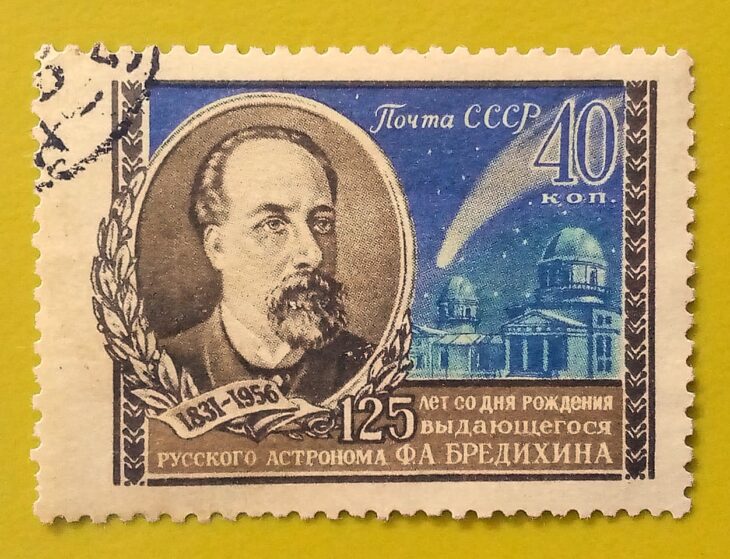
Issue: Russia USSR Fyodor Bredikhin Astronomer Stamp
Type: Stamp
Number of Stamps: 1
Stamps Denomination: 40 K,
Issue Date: 1956
Issued By: Russia POST
Pioneer of Comet Science Shines on Stamp:
The USSR stamp honoring Fyodor Bredikhin celebrates one of Russia most respected 19th century astronomers. His theories on comet tails introduced a scientific framework that helped explain their shapes and variations under the influence of solar radiation. The stamp typically shows a portrait of Bredikhin against a cosmic or observatory themed background symbolizing his lifelong dedication to the mysteries of the universe. As a director of the Pulkovo and Moscow observatories his work not only advanced Russian astronomy but influenced space science across Europe.
A Legacy Written in the Stars:
Fyodor Bredikhin scientific career was marked by precision theory and a deep curiosity about the heavens. He cataloged meteor showers and worked to understand how comets interacted with space environments. This made him a respected name in international astronomical circles. The Soviet stamp issued in his honor not only acknowledges his personal achievements but also reflects the USSR pride in its intellectual and scientific heritage. During a time when space exploration was a national priority the stamp linked past astronomical inquiry with the future of cosmic discovery. It served to inspire younger generations about the scientific giants who paved the way.
Philately Meets the Cosmos with Purpose:
Issued during the Soviet era this commemorative stamp fits within a broader theme of honoring scientists engineers and thinkers who contributed to the USSR pursuit of scientific excellence. Bredikhin image on a postage stamp symbolizes the importance of astronomy in Russia cultural and academic development. It also aligns with Soviet ambitions in space during the mid 20th century reminding the public that long before Sputnik or Gagarin there were visionaries like Bredikhin observing the skies with telescopes and theories. Today the stamp stands as a tribute not only to an astronomer but to the enduring curiosity that connects humanity with the stars above.
